Utah ranchers selling quarter and half beef
What's in a quarter or half beef? Cuts and pounds
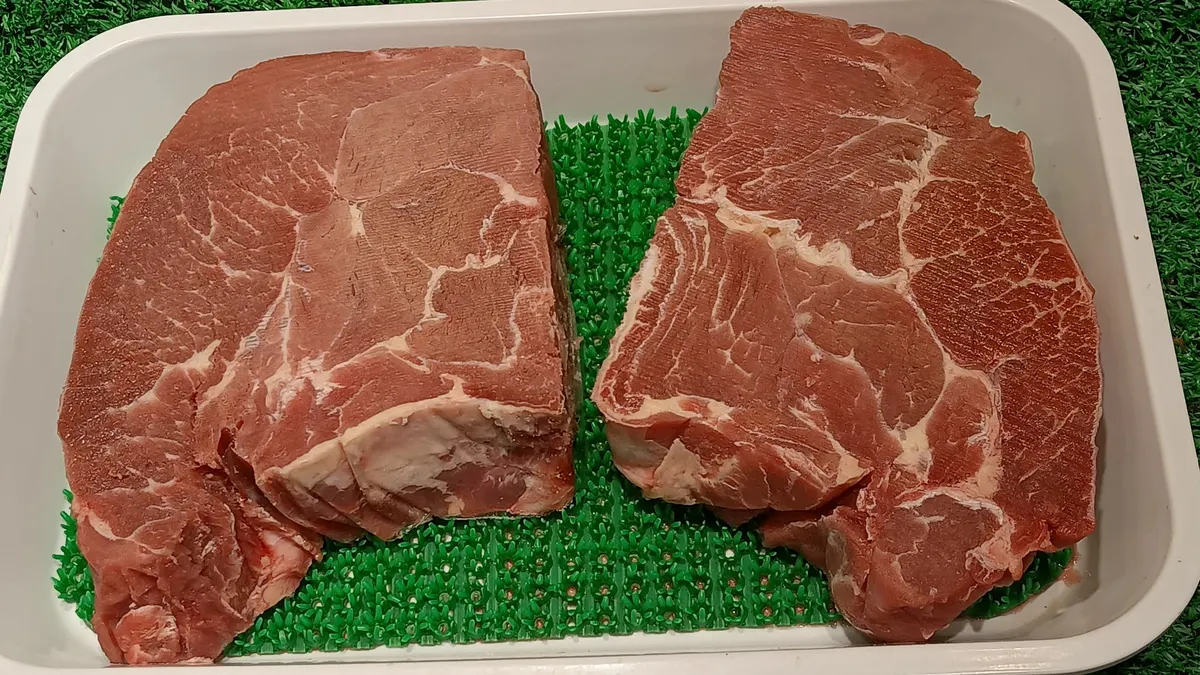
A half beef is not a freezer full of ribeyes. You get every part of one side of the animal, and most of the pounds come from the chuck and the round, which turn into roasts and ground beef. Here is what university extension guides say to expect, and the one question to ask before you pay a deposit on a quarter.
Quick answers
- Half beef: about 275 to 400 lb hanging weight and 150 to 250 lb of meat (Washington State Department of Agriculture bulk buying guide).
- Quarter beef: about 140 to 200 lb hanging weight and 75 to 125 lb of meat, with roughly 30 to 50 lb of that as ground beef (WSDA).
- Worked example: Mississippi State University Extension follows a 1,200 lb steer to about 470 lb of freezer-ready beef with mostly boneless cuts, so about 235 lb per half (MSU Extension Publication 3489). University of Wisconsin Extension runs the same size steer to about 481 lb (UW-Madison Extension).
- Rule of thumb: take-home packaged beef is about 40 percent of the animal's live weight, or 75 percent of the hot carcass weight (MSU).
Front quarter, hind quarter or split half
This is the question that matters most when you buy a quarter. University of Wisconsin Extension explains that a quarter is either a forequarter or a hindquarter from one side, unless the ranch sells a "split side" (UW-Madison Extension):
| What you buy | Cuts come from | Good to know |
|---|---|---|
| Front quarter (forequarter) | Chuck, rib, brisket and plate | Ribeyes, chuck and arm roasts, brisket, short ribs. No T-bones, sirloin or round roasts. |
| Hind quarter | Loin, round and flank | T-bones or filet and strip, sirloin, round roasts. UW notes you will not get chuck, rib or brisket cuts such as arm roasts, chuck roasts or ribeye steaks. |
| Split side (split half) | Some of both | A quarter of the meat with an assortment from the whole side. UW calls this the choice if you want cuts from both ends. |
Most share listings just say "quarter". Ask the ranch whether that means a front, a hind or a split side. In the MSU example the front of the animal holds about 55 percent of the freezer-ready beef and the hind about 45 percent (our sum of the percentages in MSU Tables 1 and 2), so a front and a hind quarter are not the same amount of meat either.
Where the pounds come from in a half beef
These are the MSU figures for a 1,200 lb steer with about 470 lb of freezer-ready beef from mostly boneless cuts (MSU Tables 1 and 2). The per-half column is the whole-animal figure divided by two, as UW Extension suggests (UW). Your own beef will differ.
| Part (primal) | Share of freezer beef | Pounds, whole animal | Pounds, per half | Cut choices (MSU) |
|---|---|---|---|---|
| Front | ||||
| Chuck | 25% | 117.5 | about 59 | Chuck roast or chuck steak, arm roast bone-in or boneless, chuck short ribs, or ground beef |
| Rib | 9% | 42.3 | about 21 | Rib steak, ribeye steak or rib roast |
| Short plate | 7% | 32.9 | about 16 | Skirt steak, short ribs, or ground |
| Brisket | 6% | 28.2 | about 14 | Whole, cut in half, or ground beef (MSU counts 1 per half) |
| Shank | 4% | 18.8 | about 9 | Shank bone with meat for soup, stew beef, or ground beef |
| Suet and hanging tender | 4% | 18.8 | about 9 | Hanger steak or ground |
| Hind | ||||
| Round | 24% | 112.8 | about 56 | Sirloin tip, top round, eye of round, bottom round and rolled rump as roasts, steaks, tenderized or cube steak, or cubed |
| Sirloin | 9% | 42.3 | about 21 | Steaks (MSU counts 8 per half) or ground |
| Short loin | 8% | 37.6 | about 19 | Porterhouse and T-bone steaks, or filet and NY strip steaks (MSU counts 14 steaks per half) |
| Flank | 4% | 18.8 | about 9 | Flank steak (1 per half) or ground |
The short loin choice is either-or. MSU notes that choosing one loin option means you cannot choose another, so you get T-bones and porterhouses, or you get filet mignon and New York strips, not both (MSU). Ground beef comes from trimmings across the animal, especially the chuck and round (UW).
Estimate your cuts
Enter the hanging weight your ranch quotes. The estimate uses MSU's note that 30 to 40 percent of the chilled carcass is lost as fat trim and bone with mostly boneless cuts, then splits the result using the MSU percentages above. For a front or hind quarter we rescale those percentages to that end of the animal. This is our arithmetic for planning, not a promise from any ranch.
| Part | Estimated pounds |
|---|
What makes your pounds go up or down
- Boneless cuts weigh less than bone-in, though UW Extension points out the amount of edible meat is the same either way (UW, MSU).
- Fat: MSU says carcass fat has the biggest effect. More outside fat means more trim and less take-home beef (MSU).
- Lean ground beef and close trimming, such as 90:10 ground, mean fewer pounds (UW).
- Aging: longer aging improves tenderness and flavor but loses moisture, and dry-aged edges get trimmed (MSU).
- Chilling: a carcass loses about 2 to 5 percent of its hot weight in the first 24 hours (MSU, UW).
- Grass-finished cattle are expected to have a lower than average dressing percentage (MSU).
- Organ meats such as liver, heart and tongue add pounds if you choose to take them home (UW).
Questions to ask the ranch
- Is your quarter a front, a hind or a split side?
- What hanging weight should I expect, and is the price per pound of hanging weight or packaged?
- Do I fill out my own cut sheet, or is it a standard cut?
- How long is the beef aged?
Next, check how much freezer space you need and what a quarter really costs per packaged pound, then compare share prices across Utah, Idaho and Wyoming.
Sources fetched October 31, 2026: Mississippi State University Extension Publication 3489, How Much Meat to Expect from a Beef Animal, University of Wisconsin-Madison Extension, How much meat should a beef animal yield?, WSDA Guide to Buying Meat in Bulk (PUB 522-017, reproduced from the Good Meat Project). No ranch or brand paid to be listed.
See something wrong? Email brad@uofyou.org.